(Note: The workbook and this class are an abbreviated version of my complete course.)
| Lesson and Focus | Handbook + Recommended Practice |
| Lesson 1 | Page 1: Fill in the details of the class times and course code Page 2: Listening pre-quiz (You can check your answers on the last page;) PRONUNCIATION STEP 1 VOWELS 1A Check your progress and check your answers VOWELS 1B Check your progress and check your answers Practice PRONOUNCING syllables: Chocolate Practice READING basic sentences (with translations) in the Spanish World Atlas Practice LISTENING while you READ: News In Slow Spanish Practice identifying and correctly pronouncing VOCABULARY in Spanish that is the same in English and Spanish using bilingual texts |
| Lesson 2 | PRONUNCIATION STEP 2 CONSONANT DIFFERENCES Check your progress and check your answers Practice READING items on Spanish “Menus en Denver” restaurants Practice VOCABULARY in songs with Lyrics Training or lyrics translate Gain insight to the history of the Spanish language through the origin of its words Practice identifying and correctly pronouncing VOCABULARY in Spanish that is similar in English and Spanish using bilingual texts (online, from the library, or on YouTube) |
| Lesson 3 | PRONUNCIATION STEP 3 DIPHTHONGS Check your progress and check your answers LISTEN to a read aloud of the Spanish version of Goodnight Moon (Buenas Noches Luna) to see an example of the word “hay” that was introduced in this lesson. Practice PRONUNCIATION with animal sounds Practice travel CONVERSATION with Mi Vida Loca (BBC) Enjoy local places that have bilingual information through EXCURSIONES! Practice identifying and correctly pronouncing PHRASES in Spanish and comparing them in English and Spanish using bilingual texts (or the same book in both languages) |
| Lesson 4 | PRONUNCIATION STEP 4 EMPHASIS Check your progress and check answers LISTEN to a read aloud of “Buenos Dias, Buenas Noches” to see examples of the verb “ESTAR” that was introduced in this lesson. Practice identifying and correctly pronouncing PHRASES in Spanish and comparing them in English and Spanish using bilingual texts (or the same book in both languages) |
| Lesson 5 | COMMON VOCABULARY INTRO Introduction to the Most Common Vocabulary Begin using bilingual and Spanish-language sources: LISTENING, READING and PRONOUNCING using questioning and answering in order to build VOCABULARY in PHRASES that are useful for CONVERSATIONS The second part to this class (“Ready, Set, Spanish! Step 2”) will practice the above-mentioned questioning and answering that helps you build fluency. You can find that class and more at Spanish courses at Colorado Free University to continue learning. Feel free to reach out to me at worldliteratenow@gmail.com with any questions or to schedule private tutoring. |
Please be sure to fill out a feedback form. (I also have a page for feedback from previous students.)
This course was designed based on my personal experience in teaching, as well as learning, language which I have summarized below:
Pronounce
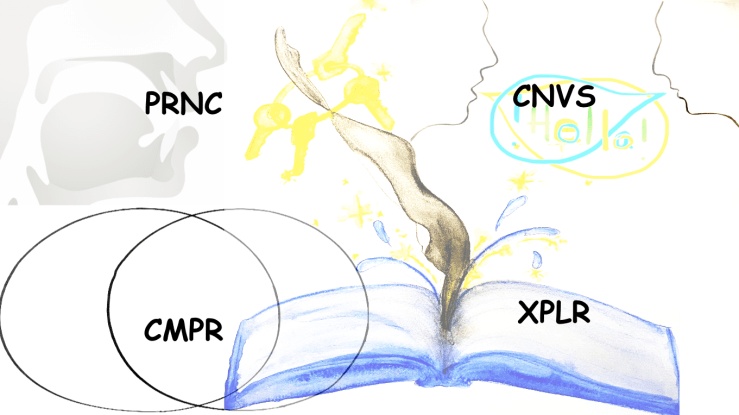
The first step to unlocking effective practice is pronunciation. The key to pronunciation is to LISTEN. Make sure that your practice includes listening to natural language sources. Lucky for you, English and Spanish have all of the same linguistic elements that easily transfer from English to Spanish! A reader of English brings so many advantageous skills to the process of learning Spanish and here I will explain two of those skills. The first skill is pronunciation. Every vowel sound in Spanish exists in English (which is not the case the other way around). There are also equivalents to almost all Spanish consonant sounds in English. Due to these similarities learning to pronounce, and also to identify accurately what is heard, is accelerated. If the learner is literate in English, it is also important to READ natural language sources, especially while listening. The second skill that English literacy provides is the use of writing that represents the sounds of the language. Writing is a tool for organizing the language allowing the reader to access it at any given time. Since English and Spanish use the same writing system, once you learn the slight differences in the way the sounds are represented, you will be well on your way to accessing Spanish!
Organize
Comparisons
In addition to the similarities in the writing systems, there are also so many similarities in VOCABULARY and GRAMMAR between English and Spanish! This program leverages those similarities in order from most similar to least similar to facilitate WRITING Spanish with the ultimate goal being to transfer written Spanish to conversational Spanish. One concept in particular that helps in making connections are “cognates”, words similar in both English and Spanish. They either come from the same root language, like Latin or Greek, or have been loaned to both languages from another language. This book presents the most frequent Spanish words through comparisons with English using word families that share the same root languages. Over 150 out of 200 of the most common words in Spanish are related to English in this way. The purpose of this book is to show you how you can start using those words now, with their correct pronunciation, in order to gain context while listening or reading, and eventually to speak or write about almost anything!
Conversation
Conversation is the most fluid and accessible key to organizing the language. At first a little slower than organization of concepts through written language, learners of conversational language make a variety of attempts at listening and speaking to find the most effective ways to communicate. Frequent LISTENING and SPEAKING practice is key to learning Spanish and is the most important factor in developing appropriate Spanish conversational skills. Here again, the correlation of frequent practice and improved language skills is undeniable. One factor that increases efficiency while practicing conversation is to have an interlocutor of natural Spanish ability. Conversation is the most imperative skill in language learning in that a language exists first and foremost for the purpose of communication through conversation anywhere in the world.
Practice
Language only exists out of necessity to communicate about the world. So there is no need for the learning of language to be broken down by topics. There is a place for any topic while practicing even the most basic aspects of language. So my first key recommendation on your language learning journey is to EXPLORE favorite topics in order to PRACTICE every day. Exploring favorite topics will incentivize the amount of practice that is necessary to learn the language. Because practice is the most important part of learning the language, you have the control over whether you learn it or not.
 WLN!
WLN! 